Parker Weber · 15 September 2026
Timing Your Domain Shift: Balancing Link Profiles and Crawler Attention for Minimal Disruption
Domain shifts require careful coordination between existing backlink structures and the pace at which search engine crawlers discover new content on replacement domains. Research indicates that abrupt changes often lead to temporary drops in indexing rates, whereas phased approaches allow link equity to transfer more steadily across the migration window.
Core Elements of a Domain Transition
Observers note that a domain shift involves transferring both technical signals and external references from one root domain to another, which includes updating DNS records, implementing 301 redirects, and monitoring how crawlers allocate their limited resources. Data from web infrastructure reports shows that crawlers prioritize sites with established authority while new domains initially receive lower visit frequencies until signals accumulate over successive cycles.
Those who have tracked multiple migrations find that link profiles carry measurable weight in how quickly a new domain gains traction, because each backlink passes authority through redirect chains that search engines evaluate for relevance and trust. At the same time, crawler attention depends on factors such as site speed, XML sitemap freshness, and internal link architecture that guides bots toward important pages without exhausting the allocated budget.
Aligning Link Equity Transfer With Crawl Schedules
Studies on web graph dynamics reveal that staggered redirect implementations help maintain steady crawler engagement rather than triggering sudden spikes that can strain processing queues. In September 2026, several documented cases demonstrated that sites which prepared redirect maps in advance experienced smoother authority handoffs compared with those that activated all redirects simultaneously.
Experts have observed that preserving anchor text diversity during the shift prevents abrupt changes in the semantic signals that crawlers use to classify content themes. When link profiles remain balanced across topical clusters, the new domain inherits contextual strength without creating gaps that might delay re-crawling of deeper site sections.
Practical Timing Frameworks Used in Industry
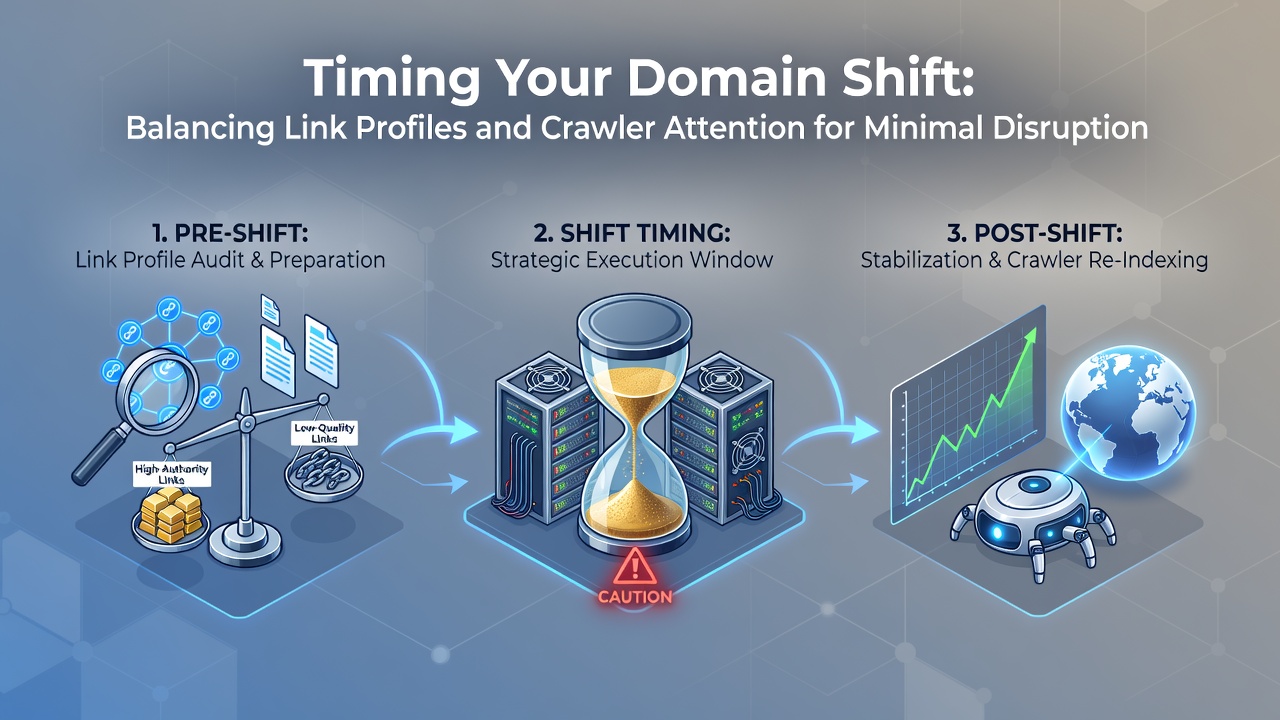
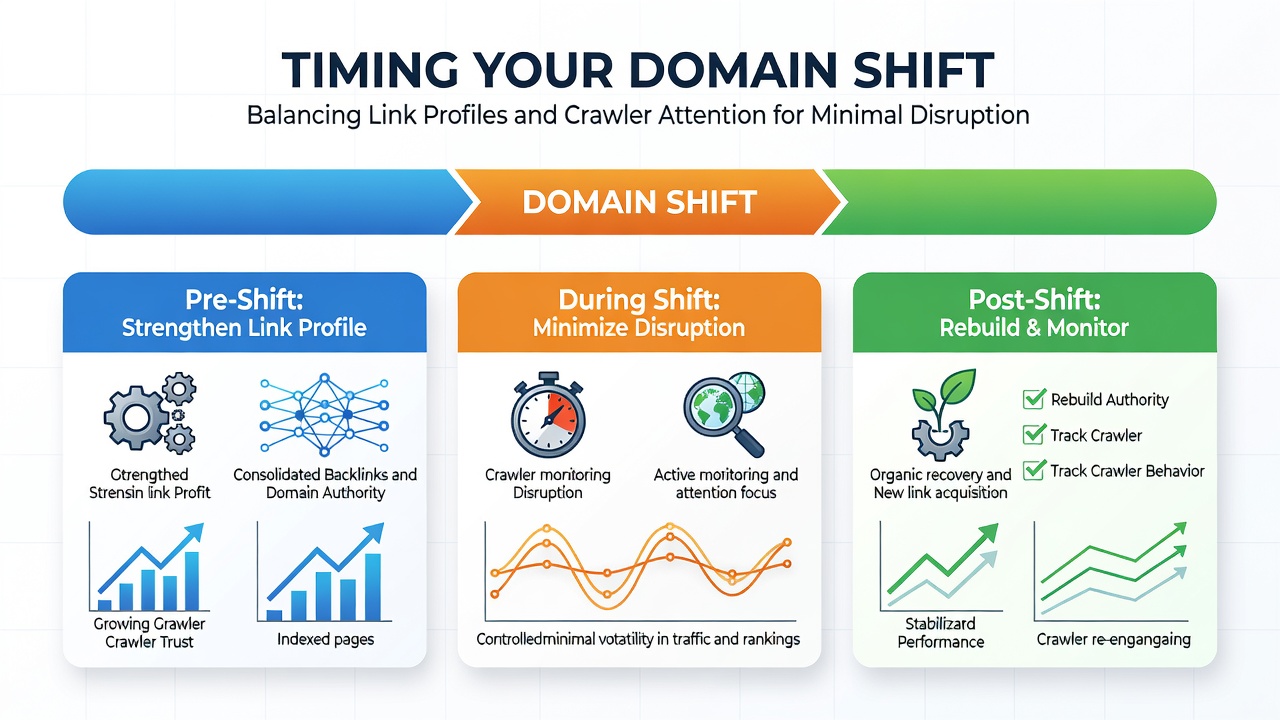
Industry analyses indicate that dividing the migration into distinct phases allows teams to monitor both link velocity and crawl frequency in real time. The first phase typically focuses on mapping high-value backlinks and setting up temporary monitoring dashboards, while the second phase activates redirects for the most authoritative referring domains first.
Subsequent phases then address remaining links and content updates, giving crawlers incremental opportunities to discover changes without overwhelming their scheduling systems. Figures from web performance repositories show that this incremental method reduces the average time to full indexing recovery by measurable margins across tested enterprise sites.
Monitoring Tools and Data Points
Analysts rely on log file analysis combined with search console data to track how often crawlers request pages on both old and new domains during the transition period. These metrics help identify whether link profile changes correlate with shifts in crawl demand, allowing adjustments before visibility gaps widen.
One documented example involved a media property that timed its shift around quarterly content refreshes, resulting in sustained crawler attention because new internal links reinforced the redirect pathways. Such coordination illustrates how external references and internal navigation can work together to keep discovery rates stable.
Conclusion
Effective domain shifts depend on synchronizing link profile management with crawler attention patterns through deliberate scheduling and phased implementation. Data continues to show that measured approaches preserve authority transfer while minimizing temporary disruptions in indexing and visibility metrics.